

What If We’re Asking the Wrong Question About Early Learning?
What If We’re Asking the Wrong Question About Early Learning?
When parents begin exploring school options for children ages 4–7, the questions often sound like this:
Is my child learning enough?
Should they be reading yet?
What if they fall behind?
These questions come from care, not fear.
But research in early childhood development suggests something worth pausing on.
What if the most important question in these early years isn’t what children are learning yet, but how their brains are being shaped to learn for life?
Why the Early Years Matter So Much
Early childhood is when the brain builds the foundation for everything that follows.
Cognitive growth, emotional regulation, physical coordination, social skills, and learning habits are all forming at once.
Research from the Harvard Center on the Developing Child shows that early experiences shape the brain’s architecture in ways that influence learning, behavior, relationships, and health across a lifetime. Strong early foundations support long-term success. Weak or rushed foundations are far harder to rebuild later.
This is why early childhood is not something to rush through. It is an investment in a child’s long-term well-being and potential.

Ages 4–7: How Children Actually Learn
Between ages 4 and 7, children are developing the internal systems that make learning possible. These include focus and impulse control, emotional regulation, language through real use, social awareness, cooperation, and confidence in problem-solving.
These skills are not built through pressure or performance.
They are built through experience.
Developmental psychologist Peter Gray explains that children are biologically driven to learn through play and exploration, not through constant instruction or evaluation.
Play allows children to integrate thinking, feeling, movement, and meaning into one process. Without it, learning becomes fragile and short-lived.
Play Is Not One Thing. It Builds Many Things.
High-quality early childhood environments protect many kinds of play because each supports a different part of development.
Physical play builds regulation, coordination, and confidence.
Imaginative play strengthens language, creativity, and empathy.
Constructive play supports early math, spatial reasoning, and planning.
Social play develops communication, negotiation, and collaboration.
Outdoor play supports focus, resilience, and sensory integration.
This aligns with developmentally appropriate practice recommended by early childhood experts.
Honoring Children’s Natural Play Schemas
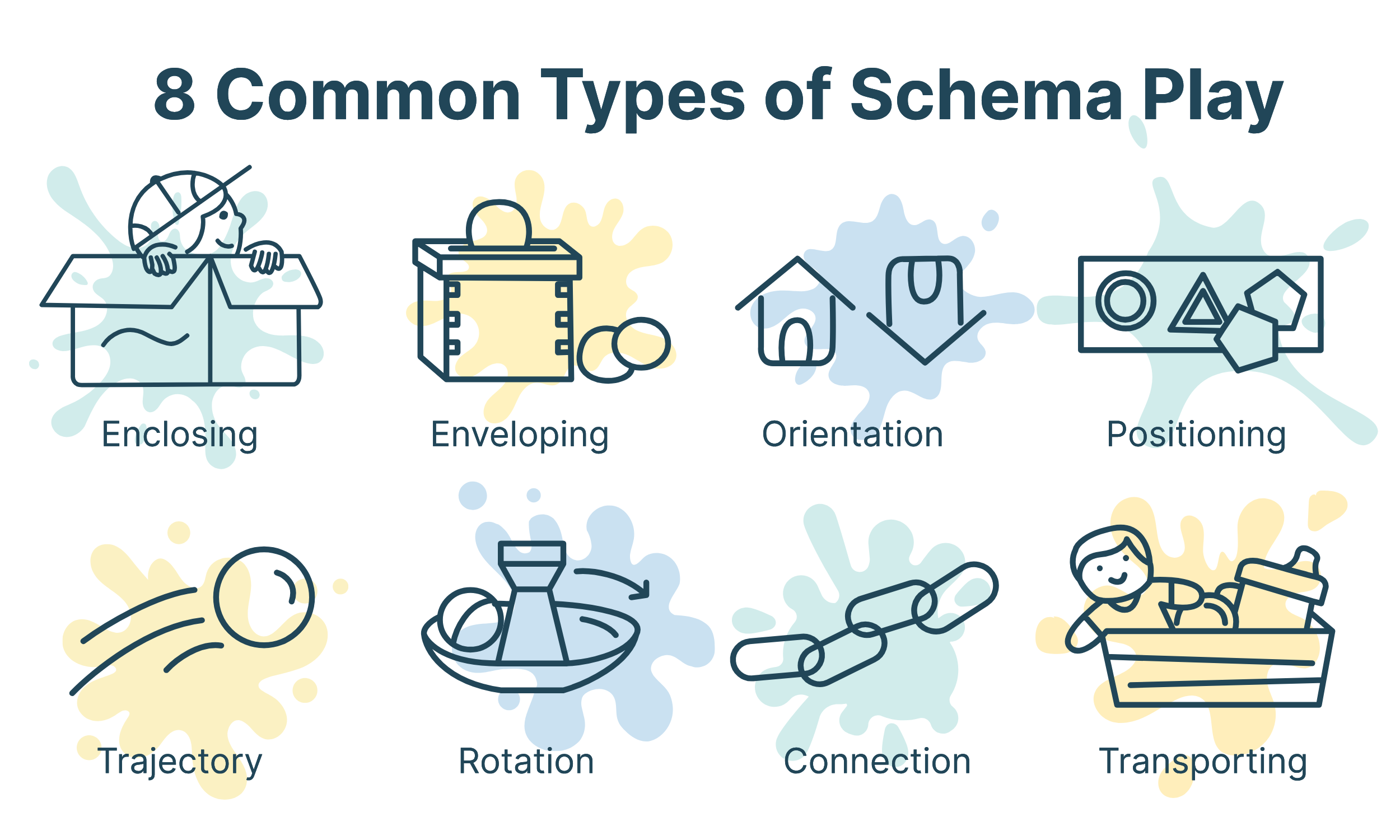
Young children do not play randomly.
Their play often follows predictable patterns called schemas. These are repeated actions that help children understand how the world works.
Common play schemas include enclosing, enveloping, transporting, connecting, trajectory, rotation, orientation, and positioning.
When a child repeatedly lines objects up, carries items from place to place, builds enclosures, throws objects, or wraps materials, they are engaging in deep cognitive work. These patterns support early math thinking, spatial awareness, coordination, problem-solving, and persistence.
When learning environments honor play schemas instead of interrupting them, children are able to explore ideas fully and build understanding through repetition.
Creativity Is Not Extra. It Is Essential.

The Reggio Emilia approach views children as capable, expressive thinkers. Its founder, Loris Malaguzzi, described children as having “a hundred languages” for expressing ideas through movement, drawing, building, storytelling, and play.
Creativity allows children to think flexibly, communicate ideas, and make meaning. When learning is narrowed too early to worksheets and right answers, many of these languages are quietly lost.
Learning to Be: Character and the Hero’s Journey
In early childhood, learning is not only about what children know. It is also about who they are becoming.
Children are forming their sense of self. How they respond to challenge. How they work with others. How they handle frustration, disagreement, and uncertainty. These are the beginnings of character.
In the Spark Studio, learning is shaped around the idea that each child is on their own Hero’s Journey. Learners read about real heroes from history, science, service, and everyday life. Not because they followed instructions well or they have super powers, but because they showed courage, perseverance, creativity, and contribution to the real world.
When children are not spending most of their day following instructions or waiting for direction, they have more time for collaboration, interaction, and real problem-solving. These experiences naturally build empathy, responsibility, resilience, and leadership. Children begin to see themselves as capable contributors and heroes in the making.
Joyful Learning Grows When Children Are Truly Trusted
A love for learning does not come from pressure or being pushed ahead before a child is ready. It grows when children feel genuinely respected and trusted.
This idea is echoed in decades of work by Dr. Maria Montessori who observed that when children are respected and allowed to work at their own pace, concentration deepens and a natural love of learning emerges. Learning unfolds best when it aligns with a child’s developmental stage, not an external timeline.
Motivation research supports this as well. Daniel Pink, drawing on Self-Determination Theory in his book Drive, explains that intrinsic motivation grows when people experience autonomy, mastery, and purpose. In learning environments where children have real ownership, motivation shifts inward. Learning becomes something they do for themselves.
This is what happens when learning development is radically respected and children are trusted to grow at the right pace, in the right way.
Here is how we make this happen at Acton:
So How Do Children Learn Literacy and Numeracy at Acton?
At Acton Academy Sioux Falls Spark Studio, literacy and numeracy are approached intentionally and developmentally.
Young learners work with Montessori-style, child-led materials on mats, using hands-on, multisensory tools that support reading, writing, math, and fine motor development. These materials are carefully designed to help children move from concrete understanding to abstract thinking at their own pace. Learners touch, build, trace, count, sort, and explore concepts before ever being asked to explain them on paper.
Literacy is woven naturally throughout the day. Children have constant access to books and spend time in DEAR (Drop Everything and Read), group reading, shared storytelling, and conversations that build vocabulary and comprehension. Mentoring days with older learners provide powerful modeling, as younger children see reading, writing, and problem-solving used with purpose and confidence.
Technology is used thoughtfully as a support, not a replacement, with innovative tools like Lexia reinforcing phonics and reading skills in a way that feels engaging and developmentally appropriate.
Rather than isolated drills or worksheets, literacy and numeracy are embedded in meaningful experiences. Children read because they are curious. They write because they have something to say. They use math because it helps them solve real problems. Over time, skills grow alongside confidence, independence, and a genuine love of learning.

As learners grow, they also begin participating in Learning Challenges and Quests that gently prepare them for project-based learning in the Elementary Studio. These collaborative, thematic experiences span areas such as art, engineering, physics, world cultures, civilizations, and architecture. Within each Quest, learners apply core literacy and numeracy skills while also developing problem-solving, creativity, teamwork, and critical thinking.
Recent Spark Studio Quests have included Levers, Wheel and Axle Exploration, Art Quest, Geography, and Games Quest, giving learners meaningful opportunities to apply foundational skills in real, connected ways.
Unstructured Outdoor Learning and Discovery Days
Unstructured time outdoors plays a powerful role in early childhood development.
Research shows that time in nature supports focus, creativity, emotional well-being, and problem-solving. Outdoor environments offer challenges no indoor classroom can replicate, encouraging children to adapt, collaborate, and persist.

Every other Thursday afternoon, Acton Academy Sioux Falls learners spend time at the Outdoor Campus near Sertoma Park.
Discovery Days are dedicated to exploration, independence, and real-life adventure. Learners climb, walk trails, build forts, practice early orienteering, develop basic survival skills, and engage in creative, open-ended play.
There are no worksheets waiting at the end. The learning happens in the doing.
A Thought Worth Sitting With
Instead of asking, is my child keeping up, it may be more helpful to ask, is my child becoming someone who loves learning?
When children’s development is deeply respected and trusted, learning becomes joyful. Curiosity stays alive. Passion has room to grow.
For children ages 4–7, in the preschool and kindergarten years, that foundation may matter more than anything else they learn.
Curious whether this could fit your child?
Explore our free parent information kit or schedule a private school tour.
