Learner-Driven Education in Sioux Falls | Acton Academy
What Is Learner-Driven Education?
A Simple Guide for Parents in Sioux Falls
Families in Sioux Falls are increasingly looking for schools that offer more flexibility, deeper learning, and a better fit for their child.
You can see it in rising searches for alternative school, microschool, homeschooling, unschooling, and hands-on learning schools.
Behind most of those searches is the same quiet question:
What does learner-driven education actually mean?
Learner-driven education is a different way of thinking about how children learn and how schools are designed to support that learning.
Children are natural learners
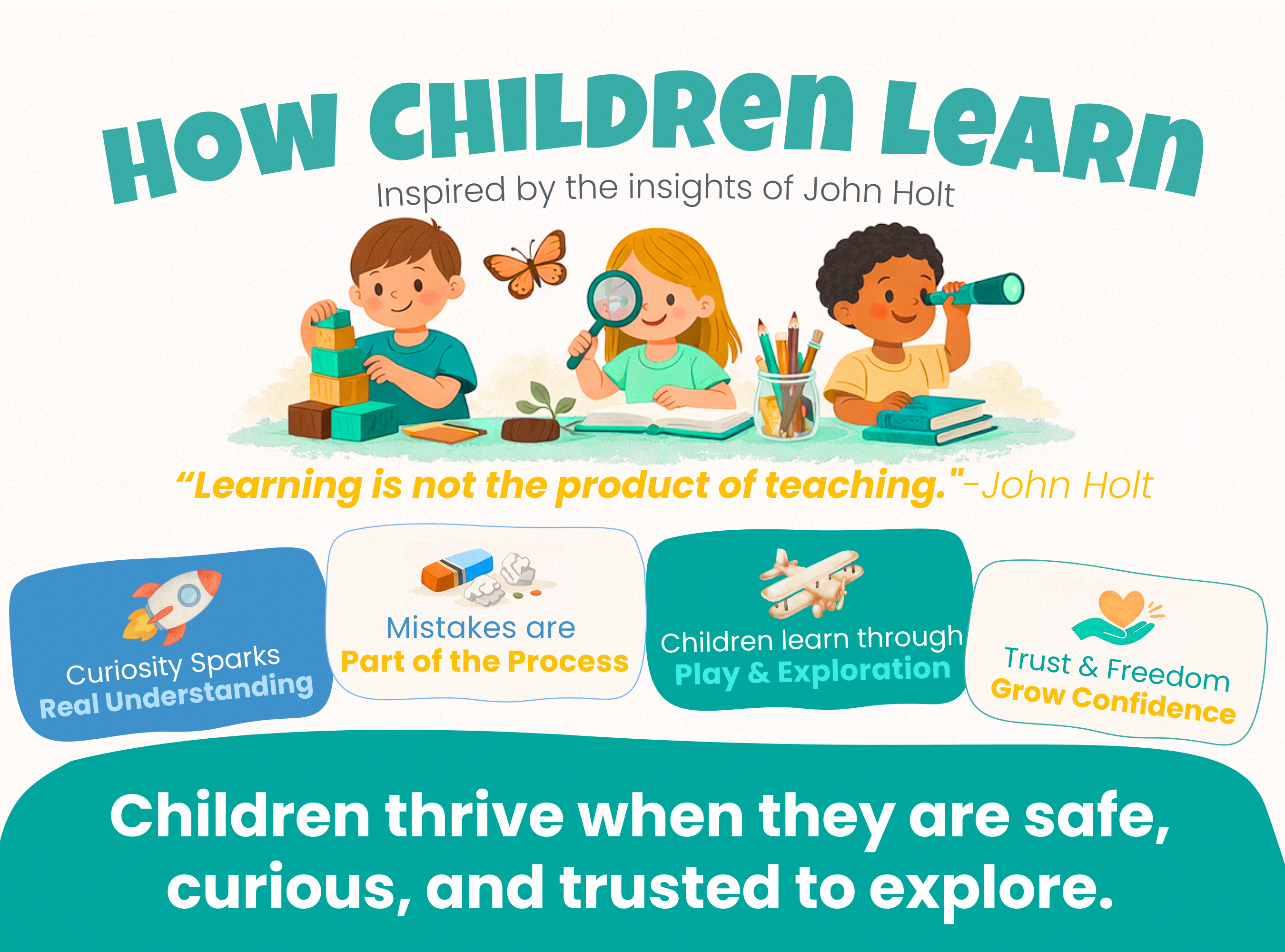
In the book How Children Learn, educator John Holt made a simple but powerful observation:
children are not empty vessels waiting to be filled. They are born learning.
Holt famously wrote:
“Children learn from anything and everything they see.”
“Learning is not the product of teaching.”
“We destroy the love of learning in children.”
His work wasn’t theoretical. It came from years of watching children closely.
What he saw is something many parents recognize instantly.
What John Holt observed about learning
Holt noticed that children learn best when they feel:
Safe
Trusted
Free to explore
He also observed that:
Children learn naturally through play, experimentation, and mistakes
Fear of failure shuts learning down
Constant correction interrupts real understanding
Deep learning happens when curiosity leads the way
When learning becomes tightly controlled, children often stop thinking for themselves. Instead of understanding ideas, they begin guessing what adults want.
These observations form the foundation of learner-driven education.
How this connects to learner-driven education
Learner-driven education reflects these observations almost exactly.
Instead of asking,
“What should we teach children next?”
It asks,
“How do children actually learn?”
Learner-driven environments are intentionally designed to:
Protect curiosity
Allow mistakes without shame
Build real responsibility
Emphasize understanding over performance
Structure still matters. It’s simply designed around how learners grow, not how systems are managed.
What is learner-driven education?
Learner-driven education is an approach where students play an active role in their learning rather than passively receiving information.
Rather than teachers directing every step, learners:
Set goals for their work
Take ownership of projects
Track progress and reflect
Learn through real problems and experiences
Adults remain deeply involved, but their role changes.
Guides act as coaches who ask thoughtful questions, set clear expectations, and hold learners accountable. The focus shifts from compliance to ownership, and from memorization to meaning.
The Learner Driven Revolution: The Story of Acton Academy:
How learner-driven education works in practice
A common concern parents have is whether children stay focused and challenged when they’re given more responsibility.
Effective learner-driven schools address this with clear systems and shared accountability.
According to the Acton Academy Parents, strong learner-driven environments combine:
Clear goals learners commit to
Public accountability through peer feedback
Mastery-based progress
Real consequences that matter to learners
Regular reflection and revision
When learners own the process, motivation shifts. Effort becomes internal, and learning becomes something they actively pursue.
Learner-driven education vs traditional school
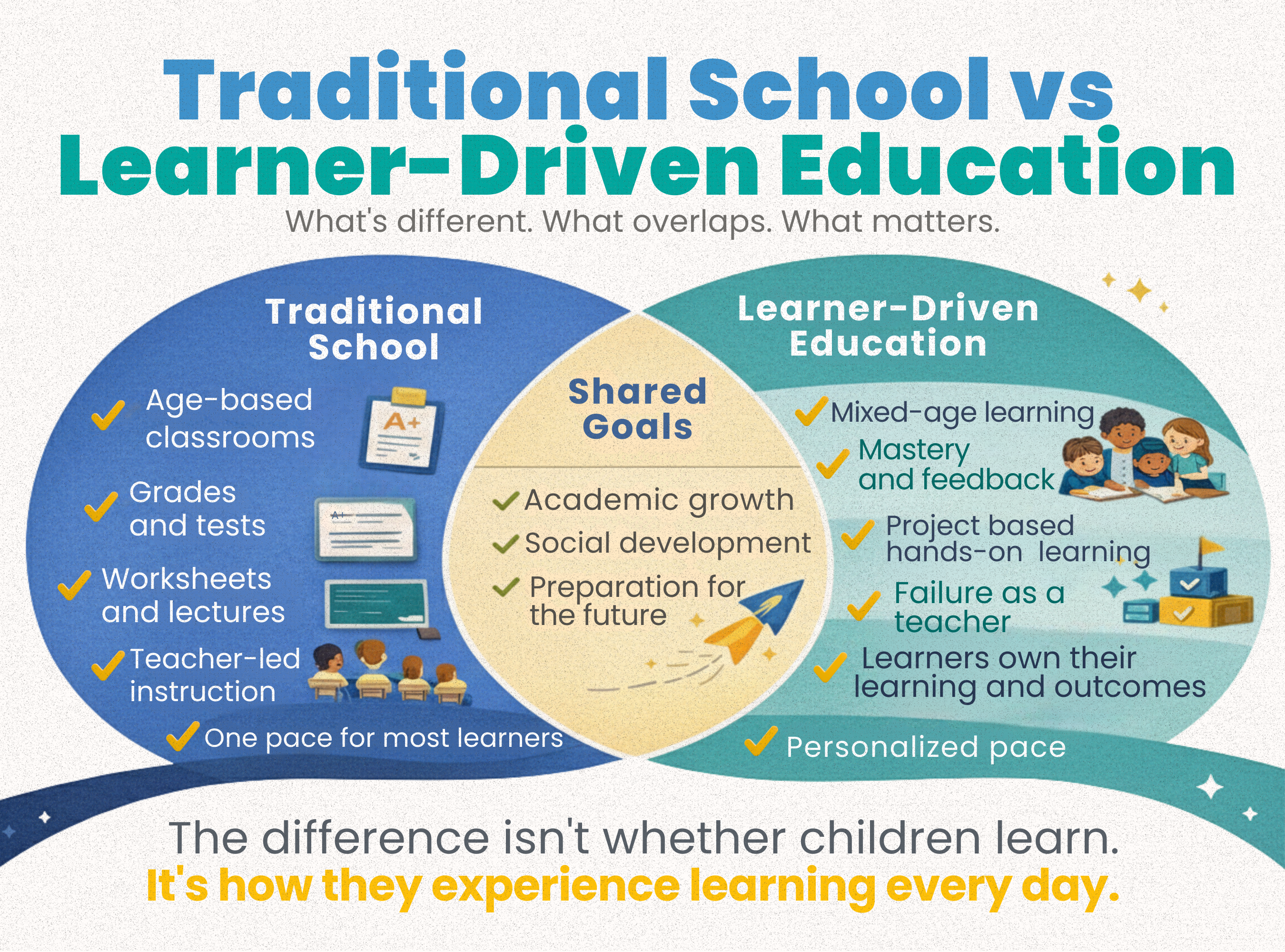
In most traditional public and private schools, learning is adult-directed. Teachers decide what, when, and how students learn, usually based on age and standardized pacing.
Learner-driven environments look very different.
Traditional school: age-based classrooms
Learner-driven: mixed-age learningTraditional school: grades and tests
Learner-driven: mastery and meaningful feedbackTraditional school: worksheets and lectures
Learner-driven: projects and hands-on workTraditional school: teacher-led
Learner-driven: learner-led with guidanceTraditional school: failure is something to avoid
Learner-driven: failure is how learning happens
Confidence and independence aren’t taught. They’re built by doing.
Curious whether this could fit your child?
Explore our free parent information kit or schedule a private school tour.
Why hands-on and project-based learning matter
Learner-driven education relies heavily on hands-on, project-based learning.
Instead of completing assignments for a grade, learners work on meaningful projects that build:
Critical thinking
Collaboration
Communication
Problem-solving
Research shared by Edutopia shows that project-based learning improves engagement and long-term understanding, especially when learners have real ownership over their work.
This is especially powerful in elementary and middle school, when curiosity, creativity and collaboration are naturally high.
Here's an example of project-based learning in Acton Academy Sioux Falls:
Learner-driven education and early childhood learning
Many parents begin exploring learner-driven education while researching preschool, kindergarten, Montessori programs, or homeschool options in Sioux Falls.
These searches often come from a shared instinct: young children should be allowed to learn in ways that match how they naturally grow, rather than being rushed into academics before they are ready.
Research in early childhood development consistently shows that young children learn best through:
unstructured, self-directed play-based experiences
movement and outdoor exploration
hands-on problem-solving and creative work
These experiences support healthy brain development, language acquisition, self-regulation, and early social skills.
This understanding closely reflects the work of Dr Peter Gray, who emphasizes the role of play, autonomy, and self-direction in healthy childhood development, as well as Maria Montessori, whose approach centers on independence, purposeful work, and respect for a child’s natural developmental pace.
At Acton Academy Sioux Falls, these principles guide our Spark Studio (ages 4-7), where young learners build foundational skills through play, exploration, and meaningful experiences that support confidence, independence, and a love of learning.
You can learn more about how we support early childhood learning here - https://actonacademysiouxfalls.org/post/earlylearningatspark
Is learner-driven education the same as homeschooling?
Not exactly, but they share important values.
Homeschooling offers flexibility and personalization, which is why it’s a growing option in South Dakota. Learner-driven schools offer similar values while adding:
A learning community
Peer collaboration
Structure and accountability
Experienced guides
Servant leadership and community involvement
For families who want the benefits of homeschooling without doing it alone, learner-driven schools can be a strong fit.
Learner-driven education in Sioux Falls

For families in Sioux Falls and the surrounding communities, learner-driven education offers a smaller, more personal learning environment than many traditional options.
At Acton Academy Sioux Falls, learner-driven education is at the core of everything.
Learners experience:
Mixed-age studios
Project-based quests
Real responsibility and accountability
Self-paced learning, reflection, and growth
Growth Mindset
Early entrepreneurial skills development
There are no grades, no homework, and no lectures designed to control behavior. Instead, learners build confidence, independence, and a strong sense of agency.
Acton Academy Sioux Falls serves local families who are seeking an alternative to traditional public and private schooling, with a focus on learner ownership and real-world skills.
If you’d like to explore this approach in more detail, our free info kit is a good place to start.
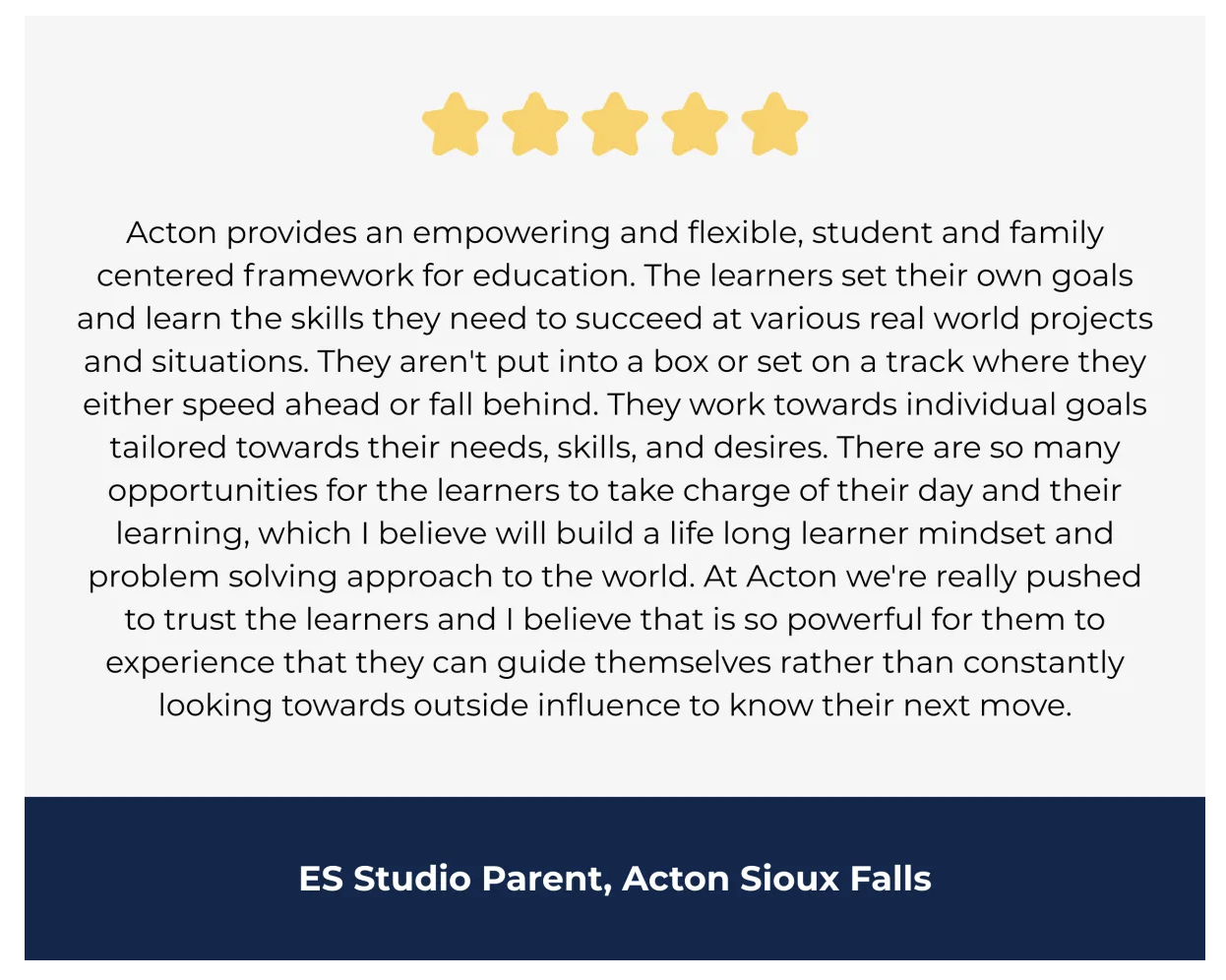
View our testimonials page here - https://actonacademysiouxfalls.org/testimonials
Is learner-driven education right for every child?
Learner-driven education works best for families who value:
Independence over compliance
Growth over comparison
Curiosity over control
Long-term skills over short-term test scores
This approach uses structure with intention, shaping it around the learner rather than forcing the learner to fit the system.
Many families find it helpful to take time to reflect and explore before deciding on next steps. You can request a free info kit to see whether learner-driven education at Acton Academy Sioux Falls is a good fit for your child and family.
What kind of child would fit the Acton Academy Education:
Final thoughts for Sioux Falls parents
For Sioux Falls parents weighing private schools, homeschooling, or alternative education models, learner-driven education offers a clear and thoughtful path forward.
The most important question isn’t where children learn.
It’s how they experience learning every day.
Trust and challenge invite learners to step forward, think for themselves, and take responsibility for their learning.
Sources & further reading
National Association for the Education of Young Children- Developmentally Appropriate Practice
Edutopia - Project-Based Learning
Acton Academy Parents – The Learner-Driven Approach: How and Why It Works
Acton Academy Resources - The Science of our Approach
Dr Peter Gray - Psychology Today, Free to Learn
Acton Academy Sioux Falls - Learning Design
What if We're Asking the Wrong Question about Early Learning? - Spark Studio (ages 4-7)
Download our FREE INFO KIT - https://actonacademysiouxfalls.org/free-info-kit
